Best Salary Benchmarking Tools in 2026 in the UK


According to the ONS Annual Survey of Hours and Earnings, UK median full-time weekly earnings reached £766.60 in April 2025, up 5.3% on the year. Pay is moving faster than most annual survey cycles can track.
I've worked with HR and Reward teams across retail, logistics, finance, and hospitality, and the question I get asked most often isn't which benchmarking tool is best. It's which one is right for a specific organisation. The answer is rarely the same twice.
This guide covers the tools UK teams most commonly evaluate, where each works well, and where it falls short.
Evaluation criteria
Each tool in this list was assessed across six criteria:
- Data freshness. Whether the underlying data is updated daily from live job postings, annually from employer survey submissions, or somewhere in between.
- UK localisation. Whether the tool supports region- or location-level filtering for UK roles, or defaults to national averages.
- Ease of use. How quickly a non-specialist can run a search and arrive at a usable salary range.
- Export and reporting. Whether results can be taken into a pay review document, board presentation, or hiring manager briefing.
- Pricing transparency. Whether pricing is publicly accessible or requires a sales process to obtain.
- Mid-market suitability. Whether the tool is designed for organisations of 200–1,000 employees, or assumes enterprise-level resources and dedicated Reward teams.
Methodology note: tools assessed via product pages, published features, and market position. No scores or star ratings applied. All tools are evaluated on the same criteria regardless of commercial relationship.
Best UK salary benchmarking tools compared
This covers platforms rather than free salary calculators: tools designed to support pay decisions at an organisational level rather than individual lookups.
HR DataHub: best for real-time UK salary data
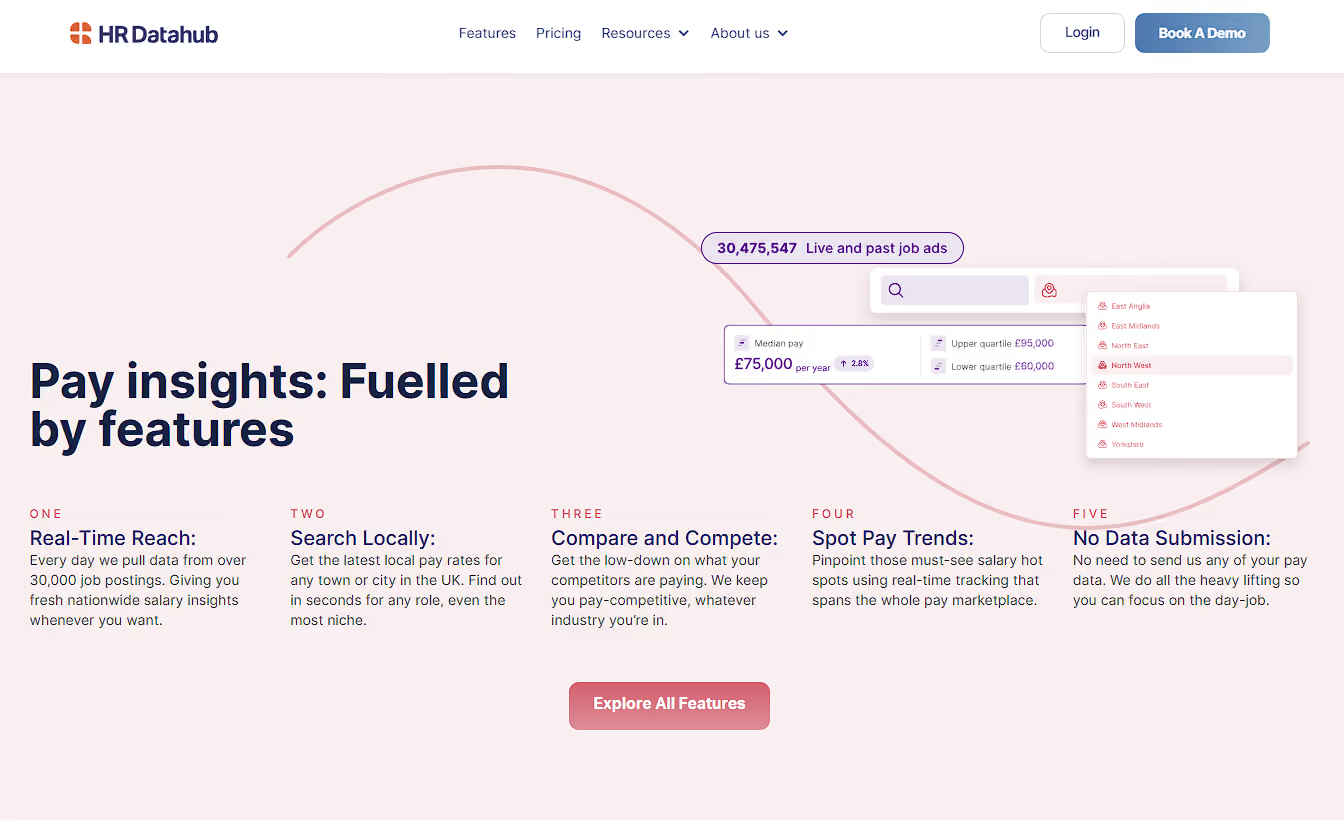
HR DataHub draws its data from over 30 million live and historical UK job postings, updated daily. Rather than asking companies to submit their salary data (the give-to-get model used by most traditional survey tools), it pulls directly from the live hiring market. That means no participation barrier, no submission cycle, and no lag between what employers are paying and what you can see.
Some providers frame job advert data as a secondary source. The distinction is that it reflects what employers are actively advertising to attract new hires today, which is the most relevant signal for offer-setting and retention conversations. As the UK’s transparency legislation rolls out, this is also the exact data that orgs are going to be exposed against rather than in-position salary data.
Our platform covers more than 1,000 UK locations and includes a suggested job title feature to help match niche or non-standard roles. Results show median, lower, and upper quartile salary ranges with trend data over time. Outputs are exportable, useful for sharing benchmarking evidence in pay review conversations or with hiring managers.
TK Maxx used HR DataHub data to inform a nationwide hourly rate increase, a use case that reflects the platform's particular strength in operational and high-volume hiring environments.
Strengths
Daily data refresh from live job adverts; no data submission required; job levelling built in across six seniority levels, scored from the advert, so roles map to a consistent structure without a formal job-evaluation exercise; strong UK breadth including regional and sector cuts; trend data over time; exportable reports you can stand behind in a pay review; book a call to talk your roles through with our salary experts. For teams building salary bands from current market data, our guide to pay structures walks through the process.
Limitations
Data reflects advertised pay rather than total compensation, and advertised ranges show what employers are offering to attract candidates, not final agreed packages. Equity, long-term incentives, and detailed benefits require a supplementary source. Not suited to executive or C-suite compensation benchmarking, and, while job levelling maps roles to a consistent structure, it does not replace a formal job-evaluation methodology where an organisation is required to run one.
Best for
HR and Reward teams that need a current view of the UK hiring market for pay reviews, offer decisions, and high-volume or location-specific benchmarking. Smaller organisations often find it covers most of what they need without additional tools.
To see how this works for your roles, see the platform features or book a call to talk it through with our salary experts.
Brightmine: best for survey-backed pay structures and formal pay review
Brightmine (formerly Cendex) is the established survey-led option for UK employers. Its Compensation Planning product draws on more than 1.5 million UK employer-reported data points across 500 job functions in 26 areas, one of the more comprehensive survey datasets in the UK.
Its real strength is depth in specialist sectors. The charity sector survey is one of the most widely used in the UK; the transport and distribution survey is similarly well-regarded. If you need a defensible peer-group comparison within those sectors, Brightmine can provide a level of specificity that broader tools cannot match. It also covers benefits and allowances, which is useful for building a full total reward picture.
Strengths
Comprehensive UK employer-reported data; strong specialist sector surveys; benefits benchmarking alongside base pay; structured pay review tooling; monthly data refresh. If you are evaluating survey-based tools, our guide to salary surveys covers when they work and when they fall short.
Limitations
Survey-based data reflects what employers reported, not what is being advertised in the live market today. If you are hiring in a fast-moving or operationally competitive environment, the lag between data collection and availability matters. When transparency comes into play, your employees won't be comparing in-position data but market driven ranges. Plus, their coverage narrows for highly niche or emerging roles.
Best for
HR and Reward teams needing a survey-backed basis for formal pay structures and annual pay review. Particularly strong for charity, transport, and distribution sectors.
Payscale: best for global and multinational employers
Payscale is a US-headquartered compensation benchmarking and management platform with a global dataset drawn from crowdsourced employee profiles and employer-reported data. Its depth is strongest in North American and large-enterprise markets. For UK teams within multinational organisations that need to benchmark roles across multiple geographies from a single platform, it offers a practical option.
Strengths
Large global dataset; multiple geographies in one platform; compensation planning tools alongside benchmarking; option to filter to employer-reported data only.
Limitations
US data is the primary strength, and UK granularity is lower than UK-native tools, especially for regional or sector-specific work. Crowdsourced data methodology attracts scepticism from some Reward professionals. Pricing requires a sales conversation.
Best for
HR teams in multinational organisations needing a single tool across geographies, or UK teams where global benchmarking is part of the brief.
Croner SalarySearch: best for HR advisory with integrated benchmarking
Croner Reward has been providing pay and benefits data to UK organisations for over 45 years. SalarySearch is the self-serve benchmarking tool within that offering. According to Croner's product page, it is a database covering more than 50,000 job records, 1,200 job titles, and 34 industry sectors across 154 UK regions. Data is collected from participating employers and published within eight weeks of collection.
Where Croner stands out is sector depth. Like Brightmine, it maintains specialist surveys for charity, care, distribution, and transport. If your organisation operates in one of those areas and needs peer-group data rather than broad market averages, those surveys offer a level of specificity that is hard to find elsewhere. SalarySearch sits within Croner's broader HR advisory offering, which suits smaller organisations without a dedicated Reward function.
Strengths
Long-established UK pay database; strong sector surveys for charity, care, distribution, and transport; 154 UK regional breakdowns; data published within eight weeks of collection; bundled with HR advisory.
Limitations
Survey lag applies as with other traditional tools. Advisory-model pricing makes standalone value harder to assess. The self-serve platform is functional but less modern than newer tools.
Best for
UK organisations in specialist sectors (charity, care, and distribution especially) and smaller teams that want benchmarking as part of a broader HR support service.
Check-a-Salary: best for free UK salary reference and small-employer tooling
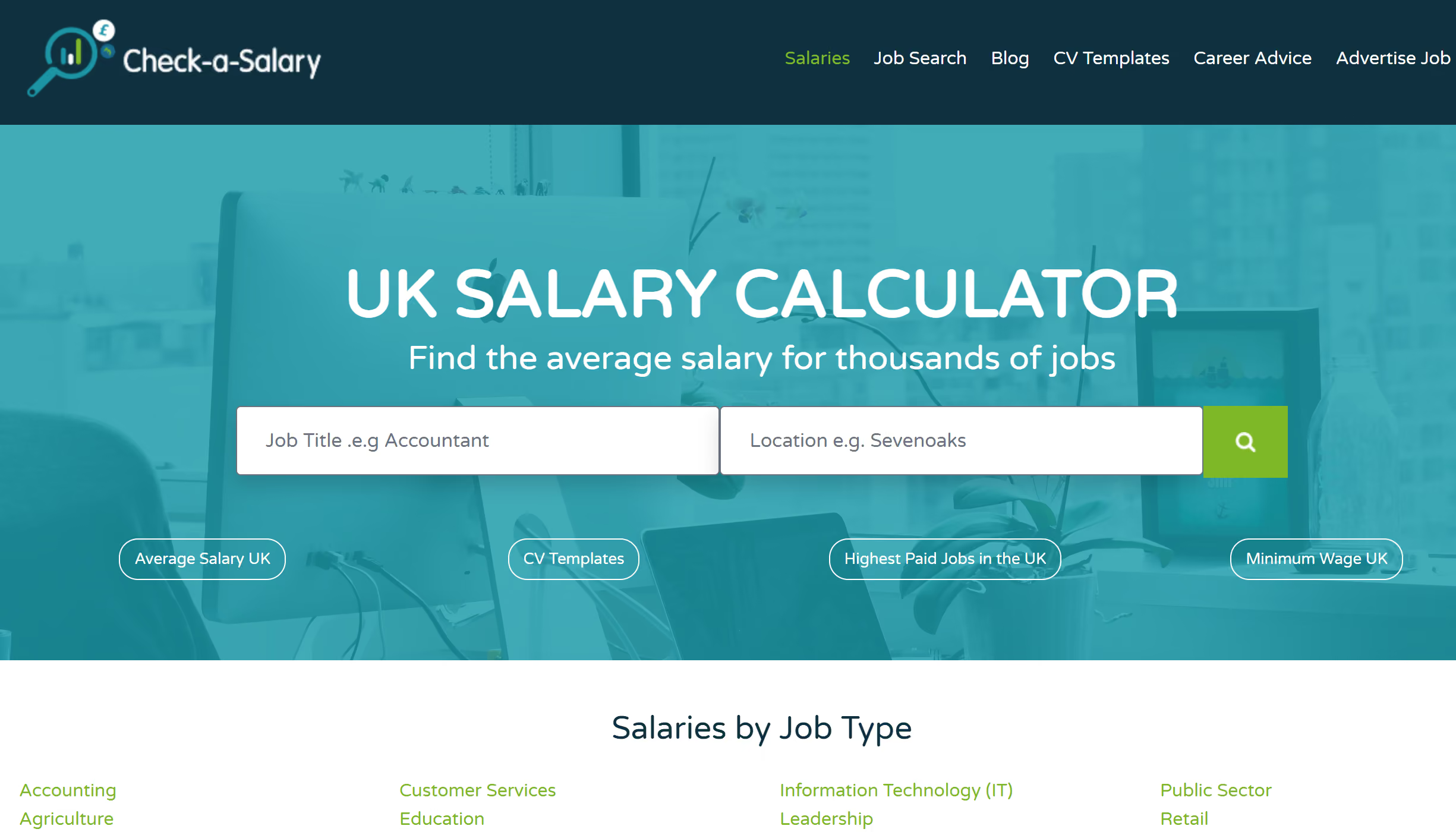
Check-a-Salary is a free UK salary data and jobs platform, launched in 2017. It aggregates earnings information from multiple sources, including UK job boards, government databases, and employer career sites, and publishes a salary lookup by role, location, and experience level, refreshed daily. The platform also runs a UK jobs portal, employer tooling including 55,000+ job description templates, and a set of free CV resources for job seekers.
It is not a dedicated benchmarking tool in the same category as the others in this guide. There is no quartile analysis, trend data, export into HR systems, or structured comparison workflow. For a Reward team building formal pay bands or a mid-market employer running a pay review cycle, it will feel thin. For an individual checking a market rate, or a small employer who wants a free salary reference alongside basic advert placement and JD templates in one place, it covers the basics.
Strengths
Broad multi-source UK salary view; daily refresh; completely free at every tier; adjacent employer tooling (job advert placement, JD templates) and free CV resources for candidates.
Limitations
Not a benchmarking tool in the structured sense. Read-only salary estimates with no quartile breakdowns, trend data, or structured exports. Aggregation across mixed source types means precision varies by role and location, and the data isn't built on controlled employer surveys.
Best for
Individuals checking market rate, small employers looking for a free salary reference alongside basic recruitment tooling, and early-stage exploratory market views before a structured benchmarking exercise.
Also worth knowing: enterprise-tier salary benchmarking options
If you are at enterprise scale or need globally standardised levelling frameworks, Mercer, Willis Towers Watson (WTW), and Korn Ferry sit in a different tier. Each offers formal job evaluation methodologies, global salary surveys, and structured grading frameworks that large organisations build their entire reward architecture around.
In my experience, the implementation and cost model is significantly different from the tools in this guide. Worth knowing about, but more infrastructure than most mid-market UK HR teams need.
Which salary benchmarking tool is right for you?
I get asked this question more than any other. The right tool depends on what you need the data for, how often you need it, and how specific it needs to be.
Start with the use case
- Building or reviewing formal salary bands (Reward/pay review): Brightmine or Croner. Survey-based, employer-reported.
- Retention conversations or mid-cycle market checks (HR Leaders): HR DataHub. Current advertised pay matters more here than last year's survey.
- SMEs setting competitive offer ranges quickly (HR/Talent Acquisition): HR Datahub. Live market data, updated daily, so offers reflect what the market is paying right now.
- Tech company compensation management: HRIS-integrated, with levelling and equity benchmarks built in.
- Benchmarking across multiple geographies: Payscale, though UK depth is lower than US.
- Enterprise scale, remuneration committee reporting: Mercer, WTW, or Korn Ferry. Different pricing and implementation bracket entirely.
Match the refresh cycle to your decision cycle
If you benchmark continuously (every time a role opens, every time a retention challenge comes up) you need a live data tool. Annual survey data works well for an annual pay review cycle. The problem I see most often is mid-market teams trying to run continuous decisions off annual data. That is where the lag becomes a real issue.
Check location filtering before you commit
For most UK mid-market employers, yes. A warehousing role in Milton Keynes sits in a different labour market to the same role in Doncaster. National averages mask that. If you have roles spread across multiple UK regions, check that any tool you shortlist can filter to location before you commit.
Match the output to the internal audience
An informal briefing for a hiring manager needs nothing more than a shareable export. Pay review documentation needs survey data with a defined methodology plus a live market check. Board or remuneration committee reporting needs an auditable survey source. Pay equity analysis needs ONS ASHE as an anchor plus a role-specific paid tool for granularity.
Before choosing, think about whose market you are actually competing in for talent. If you hire warehouse staff, you are probably competing across retail, logistics, and hospitality, not just your own sector. A narrow sector survey may be too limited. If you are a charity hiring specialist roles, a broad market average is probably misleading in the opposite direction.
Free vs. paid salary benchmarking tools - which is better?
For teams with no budget, free tools are a reasonable starting point. The Hays Salary Checker covers a wide range of common roles. ONS Annual Survey of Hours and Earnings (ASHE) data is free, government-sourced, and the most credible free reference for UK pay, especially for lower-paid and operational roles. Glassdoor and LinkedIn Salary offer crowdsourced ranges for directional checks.
The gap between free and paid shows up in role granularity, trend data, and export capability and consistency. Free tools give you a snapshot, not a trend, which means a random spike in advertised pay for a role could lead to a decision based on an outlier rather than the actual market direction.
There is also no built-in consistency of method. Different search terms, different tools, different days -- none of it is repeatable or documented. That makes it very difficult to defend a pay decision if challenged, because you cannot show your workings.
Free tools rarely go deep enough for niche roles, most give a point-in-time figure rather than a trend, and you cannot easily take their outputs into a pay review process. For a quick sense of market rate, free tools are fine. For building salary bands or making a defensible internal case, paid data is worth it.
Frequently asked questions about salary benchmarking tools
What is the best salary benchmarking tool in the UK?
It depends on the use case. For live UK market data, HR DataHub. For formal survey-backed pay structures, Brightmine or Croner. Most mid-market teams find they need two sources: one for current signals, one for structural methodology.
Are there free salary benchmarking tools worth using?
Yes, as a starting point. The Hays Salary Checker and the ONS's Annual Survey of Hours and Earnings are the most useful free options for UK teams. Neither gives you the role granularity, trend data, or export capability needed for a formal benchmarking process, but for a directional check before subscribing to a paid tool, both are credible.
What is the difference between a salary survey and a real-time benchmarking tool?
A salary survey collects employer-reported data, usually annually, and publishes results six to twelve months after collection. A real-time tool like HR Datahub collects job advert data daily, reflecting what employers are actively advertising right now. Surveys offer methodology rigour; real-time tools reflect current market reality rather than outdated assumptions, giving you live pay evidence you can stand behind. The two answer different questions and work best together. For more on when each is the right choice, have a look at our guide to salary surveys.
How do I benchmark salaries in the UK?
Start by identifying who you actually compete with for talent, not just your own sector, but any employer hiring similar skills in similar locations. Choose a data source that matches your comparator group, pull salary ranges at median and upper quartile, map them to your internal roles, and compare. For a step-by-step walkthrough of the salary benchmarking process, read our guide to salary benchmarking.
How do I know if my salaries are competitive?
Benchmark your current pay against market data for the same roles, at the same level, in the same location. A good tool will show where you sit relative to the lower quartile, median, and upper quartile. If you are below median on roles you struggle to fill or retain, that is the signal to act on.
How do salary benchmarking tools support pay equity?
Benchmarking tools support pay equity by replacing subjective pay decisions with market-referenced evidence, making it easier to identify where internal pay gaps exist relative to the external market. For organisations preparing for greater pay transparency, a documented benchmarking process is the practical foundation. The ONS Annual Survey of Hours and Earnings provides a free national baseline. For more on building salary bands as part of this, check out our guide to pay structures.
The most practical choice for most UK teams
For most mid-market UK HR teams, the practical choice is between a survey-based tool (Brightmine or Croner) for formal pay structure work, and a live pay evidence platform (HR Datahub) for current hiring decisions and pay reviews. Those two use cases have different data requirements, and a single source rarely covers both equally well.
One thing I always tell teams: test the data before you commit. If a tool offers a free trial, use it. If it is a traditional survey, ask the provider to run a sample of ten roles and show you what comes back. The best question to ask is not 'who participates in this survey?' but 'what does the actual usable data look like for the roles I care about?'
Salary benchmarking is more art than science. Even the best data source will not give you a precise answer. The job is to make the most informed decision you can with the information available, stay pragmatic, and think about what is right for your specific situation.
If you want to see what live UK salary data looks like in practice, see the platform features of HR Datahub or book a call to talk your roles and use case through with our salary experts.
LATEST WEBINAR
.avif)
Guides, templates and tools to help you approach pay with more confidence, clarity and consistency.


Read through more blogs
%2520(1).avif)










.avif)



.avif)
.avif)



.avif)






.avif)



.avif)
.avif)
.avif)
.avif)
.avif)
.avif)
.avif)
.avif)