Mercer Salary Benchmarking vs HR Datahub: Which is Best for UK Pay Decisions?


Salary benchmarking data is only useful if it reflects the market you're operating in right now. Our 2025 pay transparency research analysed 2.8 million UK job ads and found that more than three quarters now include a salary range, which means the pay data behind those published figures has to stand up to scrutiny. The source, and how current it is, makes a significant difference to the decisions it supports.
Mercer's Total Remuneration Survey (TRS) is one of the most established salary survey programmes available, built on employer-submitted pay data and a structured global methodology. HR Datahub takes a different approach: live UK job-market data, updated daily from job listings across multiple sources, with no survey submission required.
I've compared both across five categories that matter most for UK mid-market teams, so you can decide which gives you pay evidence you can defend for the decisions in front of you.
The short version: HR Datahub scores higher overall for mid-market UK teams (200 to 1,000 employees). Mercer wins on total remuneration depth and global coverage. Some larger organisations will definitely benefit from using both; for most mid-market teams, one will often be enough and depends on what they need.
Mercer vs HR Datahub: Detailed Comparison
How have we compared Mercer vs HR Datahub?
I've broken down the comparison across five categories that matter most to UK HR and Reward teams:
- Data freshness and coverage
- Ease of use and accessibility
- Customisation and granularity
- Cost and return on investment
- Integration and reporting
How the scores work
Each category is scored out of 10. Here's what the scores mean:
- 10/10 = best-in-class for most mid-market UK employers in that category
- 5/10 = workable, but with meaningful constraints for typical use
- 1/10 = not a realistic fit for that need
Scores are calibrated for a UK company with 200–1,000 employees without a large dedicated Reward function. They're intended to guide your decision, not serve as a scientific verdict.
Data freshness & coverage
Where your data comes from, and how recently it was collected, shapes how useful it is when a pay decision needs to be made today.
Mercer: 6/10
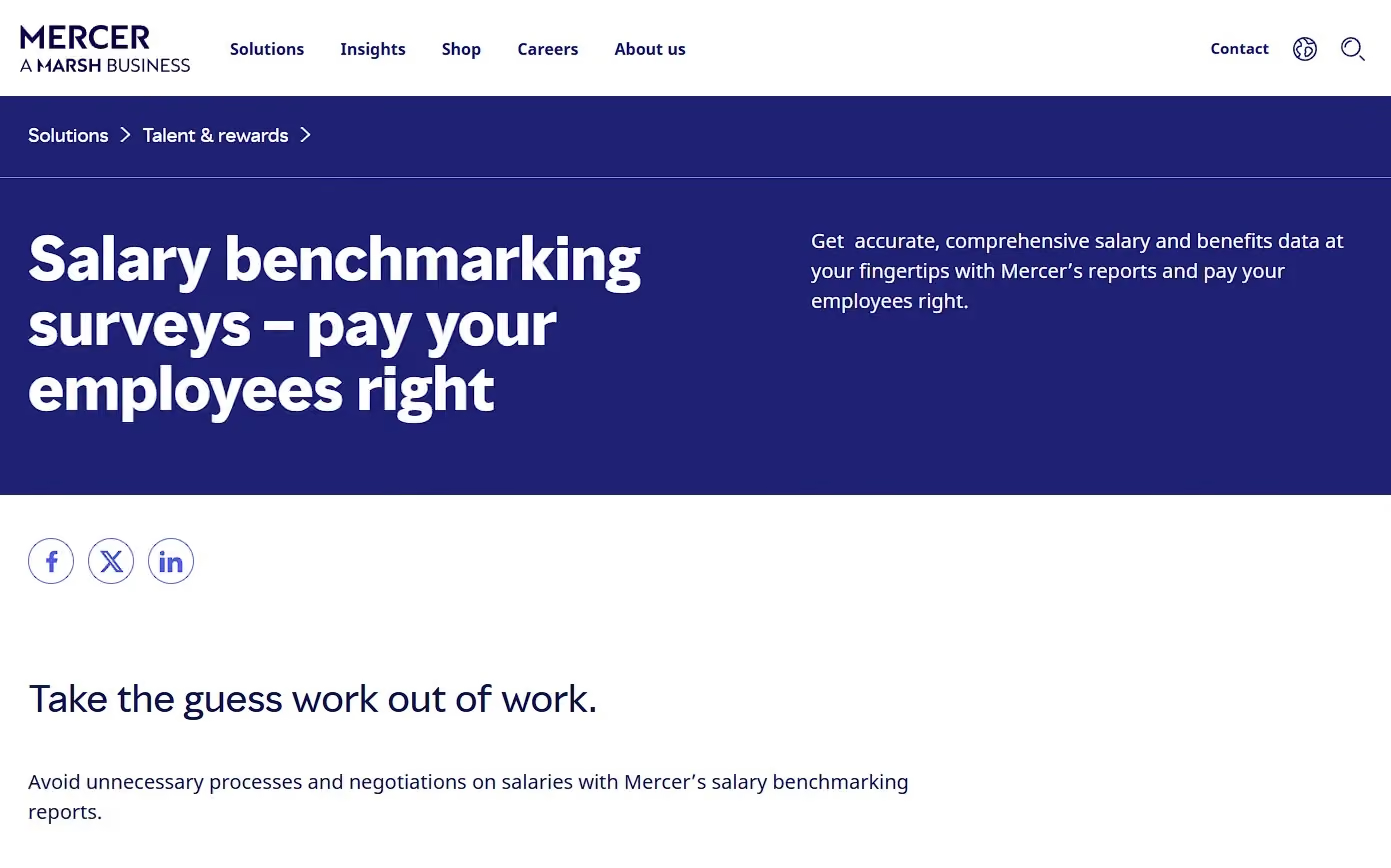
Mercer is very much a function-led survey. It's strong for head office and professional roles, and it shares the same fundamental limitations as traditional salary surveys: the data is a snapshot, and it ages quickly.
Who it's best for: Organisations in pharma, financial services, law, and tech; teams benchmarking senior professional or executive roles; global enterprises needing consistent methodology across countries.
Data source and methodology: Employer-reported actual salaries, collected annually via Mercer Data Connector and matched using the Mercer Job Library. Covers base pay, bonus, benefits, and long-term incentives in one dataset. The UK is one market within a 140-country programme; local data depth depends on UK participant volume.
Strengths
- Actual incumbent pay, not advertised ranges
- Dedicated industry surveys for pharma, banking, energy, and other specialist sectors
Weaknesses
- Data is a snapshot that ages quickly; the market can move and you won't see it until the next cycle
- The sweet spot is high-value professional roles; anything below around £35,000, they struggle. Manufacturing, retail, hospitality, and construction are not well served
HR Datahub: 8/10
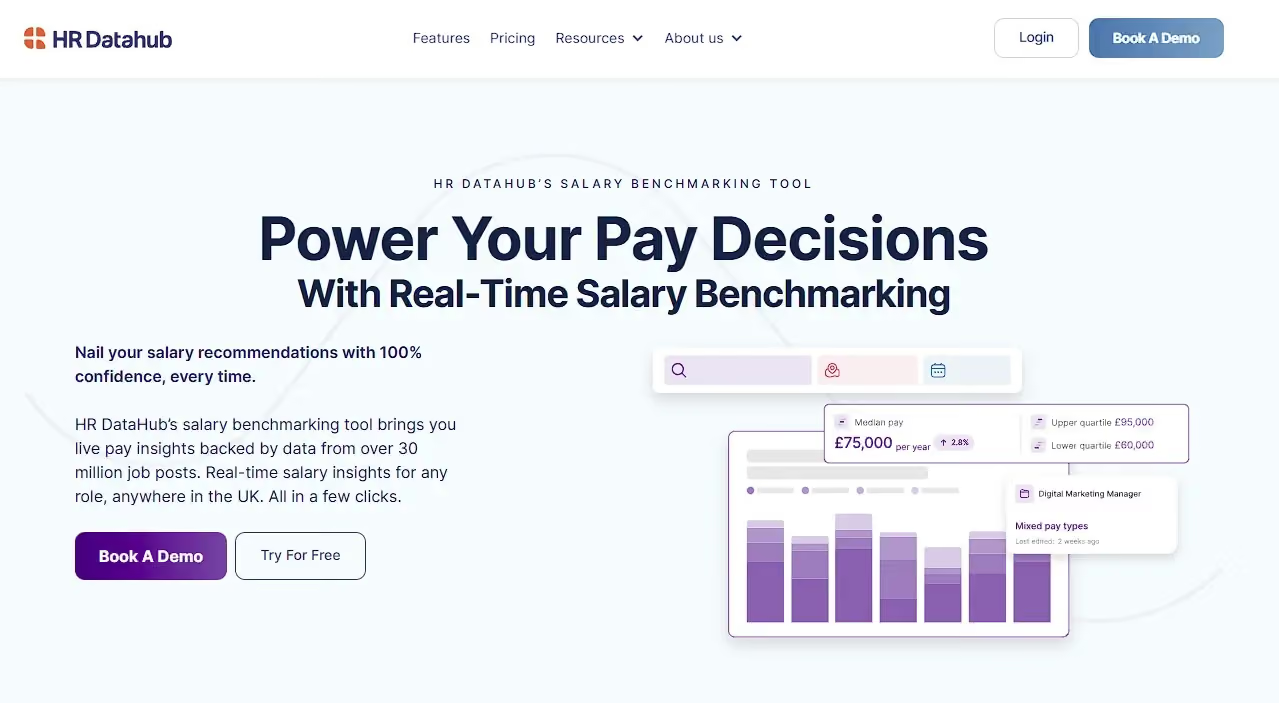
HR Datahub pulls live job advert data daily from across the UK market. We provide a range rather than an exact salary (in line with the UK government’s latest transparency guidance), and the data you get reflects what the market looks like right now.
Who it's best for: UK mid-market teams; operational and high-volume hiring sectors; teams that need current market signals for active hiring or live pay reviews.
Data source and methodology: Live UK job listing data, collected daily from multiple sources including LinkedIn, Indeed, Glassdoor, Reed, TotalJobs, and others. Coverage is strong for mid-management, operational roles, and volume hiring sectors including retail, logistics, hospitality, and manufacturing.
Strengths
- If you're looking to hire, see who you're competing against. If you're looking to retain, see what your people are seeing when they look around
- Full transparency of who your competitors are and what they're paying, with regional granularity that national survey data can't provide
- Bonus, shift allowance and remote-working prevalence surfaced alongside base pay, drawn from live job ad data
Weaknesses
- Advertised ranges rather than actual appointed salaries; you don't know the final offer within that range
- No board-level or C-suite coverage.
The data source trade-off: Survey data is real incumbent data: what someone is actually earning at time of submission. Advertised data reflects what the market is competing at right now. The question is which is more useful for the decision you're making.
Verdict
Mercer is best for: Total remuneration benchmarking, senior professional and executive roles, global pay structures.
HR Datahub is best for: Operational and emerging roles, UK location-specific data, live market signals for active hiring.
Ease of use & accessibility
Getting to Mercer's data requires meaningful upfront effort, and that effort repeats every year.
Mercer: 4/10
Who it's easiest for: Organisations already familiar with Mercer's IPE methodology and survey process.
Workflow: IPE is a robust levelling methodology and fairly easy to use at first. But once you've applied it, it gets quite complicated, with lots of different levels. Matching the right level is hard work if your organisation isn't already graded using Mercer's methodology.
Give-to-get participation: Access to TRS is discounted for organisations that submit their own pay data each year. Without participation, per-job pricing is available but impractical for broad benchmarking. Full pricing details are in the Cost section below.
Strengths
- Mercer WIN provides a functional platform for filtering and analysing results, with annual survey meetings for peer benchmarking discussion
- Machine learning in Data Connector improves submission accuracy over time
Weaknesses
- IPE levelling is complex for organisations not already using Mercer's grading structure
- The submission process requires Reward expertise and any errors in job matching affects the quality of the result
HR Datahub: 9/10
Who it's easiest for: HR generalists and Reward professionals who need pay evidence they can defend, from live market data, without specialist training.
Workflow: Search by job title, filter by location and sector, and get live salary ranges precise to the role, location, and seniority you're benchmarking. No job matching and no methodology to learn.
Strengths
- Accessible to the full HR team; results are clear enough to present directly to hiring managers and leadership
- Multiple team members can benchmark simultaneously without creating bottlenecks
Weaknesses
- Governance-grade audit trails are not the intended output
Verdict
Mercer is best for: Organisations with established Mercer methodology already in place.
HR Datahub is best for: Busy HR teams who need pay decisions they can stand behind, grounded in current market reality, without a specialist bottleneck.
Customisation & granularity
How far you can slice the data determines how useful it is for the specific decisions you're trying to make.
Mercer: 8/10
Filters: Industry, company size, geography, function, and seniority level via IPE. Dedicated industry surveys add depth in pharma, financial services, energy, and other specialist sectors. IPE is Mercer's global levelling framework, covering seniority bands from entry level to board.
Strengths
- Deep coverage of senior professional roles with consistent levelling across functions and geographies
- Comprehensive framework for organisations building formal job architectures from scratch
Weaknesses
- Roles need to map to the Mercer Job Library; if yours don't, you're working from the nearest equivalent
- Data tends to be national; Mercer can't tell you about salary hotspots across different parts of the country
HR Datahub: 7/10
Filters: Keyword search by job title, sector, location, and company size where data allows.
Location granularity: HR Datahub can give you a real deep-dive cut depending on sample size across different locations in the UK. That level of regional detail is rarely available from national survey data.
Strengths:
- Flexible keyword search surfaces niche and emerging roles naturally, without needing a job catalogue
- Competitor visibility: see exactly what specific employers in your area are advertising for equivalent roles
- Job levelling built in across six seniority levels, scored from the advert, so roles map to a consistent structure without a formal job-evaluation exercise
Weaknesses:
- Senior-level benchmarking where total reward components matter is outside current scope
Verdict
Mercer is best for: Structured job architecture, senior professional benchmarking, full total reward breakdowns by seniority level.
HR Datahub is best for: Flexible role search, UK regional granularity, operational and niche roles.
Cost & return on investment (ROI)
Mercer's cost is rarely just the subscription fee. For mid-market teams, the honest number to work with is total cost of ownership.
Mercer: 4/10
Pricing model: TRS pricing is not publicly disclosed and varies by country coverage, participation status, and package type. Participants receive a discount of over 50% on TRS access in return for contributing their data. Without participation, individual roles are available via MarketPricer at $300 USD per job.
Total cost of ownership: Based on conversations with mid-market clients, you're probably looking at about £10,000 once you factor in someone's time and the survey cost. If you want specific cuts, additional industries, or modelling, the price can reach £25,000 to £30,000. These are estimates from practitioner experience, not published Mercer figures.
Strengths
- The data underpins significant pay structure and governance work, and participants receive a meaningful discount for contributing
Weaknesses
- Opaque pricing; total cost of ownership extends well beyond the headline subscription fee

Pricing model: Subscription-based. No participation overhead, no per-job fees, no consulting add-ons. What you see is what you pay.
Strengths
- Predictable costs with no hidden overhead
- Full team access at no additional per-user cost
- No annual submission process consuming the Reward team’s resources
Weaknesses
- Fuller total reward data beyond bonuses, shift allowance and remote-working indicators, such as actual bonus amounts, benefits, long-term incentives, are not yet in scope
Verdict
Mercer is best for: Organisations that can justify the total investment through formal governance requirements or multinational pay structures.
HR Datahub is best for: Mid-market teams looking for proportionate benchmarking costs with no participation overhead.
Integration & reporting
Mercer and HR Datahub have fundamentally different models here, which reflects a broader difference in how each product is built.
Mercer: 6/10
Reporting: Mercer WIN provides online filtering and analysis by industry, function, geography, and seniority level. "What if" modelling lets teams test competitiveness against different market cuts. Results export to Excel.
HRIS integration: Survey data does not integrate directly with HRIS systems unless the organisation purchases Mercer ePrism separately. Without it, teams combine data exports with internal records manually.
Strengths
- In-platform analysis with scenario modelling and industry-specific reporting for sector participants
Weaknesses
- HRIS integration requires an additional product (Mercer ePrism)
- Results require familiarity with Mercer's methodology to interpret accurately
HR Datahub: 8/10
Reporting: Live data is available on screen and exportable. Results are designed to be understood without specialist knowledge, which makes presenting to leadership straightforward.
HRIS integration: HR Datahub operates on a self-serve, on-demand model rather than continuous HRIS sync.
Strengths
- Results are easy to share across the team without needing specialist interpretation
- Live pay evidence you can take straight into a decision and defend to hiring managers and leadership
- Multiple users can access and run queries simultaneously
Weaknesses
- Not designed for deep HRIS integration or automated data syncing
Verdict
Mercer is best for: Organisations that need detailed total reward reporting, "what if" modelling, and structured analysis by seniority level.
HR Datahub is best for: Teams that need live, presentable pay evidence they can act on with confidence, without complex interpretation.
Who should choose what between Mercer salary benchmarking and HR Datahub?
Choose Mercer if:
- You need total remuneration data for senior professional, executive, or board-level roles
- You have dedicated Reward resource and formal governance requirements
- You operate across multiple countries and need a consistent global methodology
Choose HR Datahub if:
- You need live UK market data now, for active hiring or a pay review that can't wait for the next survey cycle
- Your workforce is predominantly operational or mid-management, or includes sectors like retail, logistics, or hospitality
- You don't have a dedicated Reward specialist and need something the whole team can use without training
HR Datahub isn't trying to replace Mercer. Rather it fills the gaps and makes current market pay data easy to access: operational roles, emerging roles, regional granularity, and sectors where traditional surveys don't have the data.
A quick checklist to help you decide
- Where do your roles sit in the salary range? Mercer is strongest for professional and senior roles; as a rule, anything below around £35,000, they're going to struggle.
- Do you have someone to manage the submission? Expect at least a week of internal resourcing to complete the Mercer submission properly, including resubmits.
- Do you need total remuneration data? Mercer TRS covers bonus, benefits, and long-term incentives. HR Datahub focuses on base salary and advertised compensation.
- Do you need data across multiple countries? Mercer covers 140+ countries. HR Datahub is UK-specific.
- How urgent is your requirement? HR Datahub reflects the market now and refreshes all year round, so you're not waiting for the next cycle. Mercer's survey cycle is annual.
Frequently Asked Questions
Do you have to participate in a Mercer survey to access the data?
Technically no, but the economics push you towards it. Non-participants pay full price for TRS reports or use MarketPricer for individual role lookups, neither of which scales well. Participation means submitting your organisation's pay data annually, which requires someone who understands IPE job matching and can manage the resubmission cycle. For mid-market teams, that overhead is the real cost of entry.
What is the difference between Mercer survey data and real-time salary benchmarking?
The practical difference is what each data type tells you. Mercer's survey data answers "what are people in this role actually earning right now?" HR Datahub's live data answers "what would I need to offer to hire someone into this role today?" If you're building formal pay structures or reporting to a remuneration committee, the first question matters more. If you're making an offer this week or checking whether your ranges are still competitive, the second one does.
Is Mercer salary benchmarking worth it for mid-market companies?
It depends on what you'd actually use it for. If the answer is "benchmarking 15 senior roles for a board presentation once a year," that might justify the investment. If the answer is "checking whether our warehouse operative salaries are competitive across three regions," it won't. The cost, complexity, and annual refresh cycle need to earn their keep against a specific use case. For a broader view, take a look at our guide to salary surveys to understand what traditional benchmarking can and can't deliver for mid-market teams.
Can you use Mercer and HR Datahub together?
Some larger organisations do. The typical pattern is Mercer for governance and total reward reporting on senior roles, with HR Datahub filling the gap for operational roles, regional data, and live market checks between survey cycles. For most mid-market teams, one source of live pay evidence is enough to make pay decisions with confidence.
Final verdict: should you choose Mercer or HR Datahub?
The choice comes down to what you're benchmarking and who's doing the work.
If your benchmarking requirements are genuinely centred on senior professional or executive roles, multinational pay structures, or governance-grade total remuneration data, Mercer TRS is built for that job. The investment is proportionate when those are genuine requirements.
That said, for most mid-market UK teams, it’s a different picture. My honest two-word summary of Mercer compared to HR Datahub: expensive and difficult. And it's worth understanding that Mercer's model, like most traditional survey providers, is built around consultancy and providing more and more services.
HR Datahub is built differently: everything is self-service, and everything you need to make a pay decision is already in the platform. That difference in business model shapes the experience at every stage, from onboarding to day-to-day use.
HR Datahub is made for HR and Reward teams who need live pay evidence they can defend, without consultancy overhead. To see how live data supports pay decisions you can stand behind, read our guide to competitive pay for some practical strategies to try.
Book a call with our team to see how we can help you make defensible, well targeted pay decisions.
LATEST WEBINAR
.avif)
Guides, templates and tools to help you approach pay with more confidence, clarity and consistency.


Read through more blogs

%2520(1).avif)










.avif)



.avif)
.avif)



.avif)







.avif)



.avif)
.avif)
.avif)
.avif)
.avif)
.avif)
.avif)
.avif)