How to Reduce Employee Attrition in 2026
.avif)

Give a struggling team a pay rise, and attrition often drops, but only for a while. Six months on, the same people who got the raise start handing in their notice anyway, because pay was never the real problem in the first place.
Gallup's research suggests managers account for at least 70% of the variance in whether a team stays engaged, which usually matters more to whether an employee stays than what's in their pay packet. Misdiagnosing attrition as a pay problem is one of the most common mistakes I see among mid-market UK employers.
If you're losing staff fast, a single initiative won't fix it. The real fix is to diagnose exactly what’s driving people out the door, then apply the right strategy to curb it. In this guide, I'll cover how to calculate your attrition rate, the root causes behind it, five interventions that work, and how to know if they're effective.
How to Reduce Employee Attrition at a Glance
- UK staff turnover averages 34% a year, but that ranges from around 25% in public administration to over 50% in hospitality, so "normal" depends entirely on your sector.
- Gallup research says 42% of employee turnover could have been prevented, most often a manager conversation that never happened.
- Five fixes move the needle fastest: live pay benchmarking, employee-manager relationship, visible career progression, stronger onboarding, and flexible working.
- Fixing pay compression alone won't solve attrition if the real problem is a weak manager relationship or a broken first 12 weeks.
- Track all employee’s reasons for resignation and their length of service, so you know the root cause of attrition and how to fix it.
What is employee attrition?
Employee attrition is the ongoing, natural loss of staff through resignation, retirement, or other departures, measured as a share of your workforce over a set period. Most UK employers track it annually: leavers divided by average headcount, multiplied by 100. For instance, a 40-person team that lost 10 people over the year has a 25% attrition rate.
What causes employee attrition?
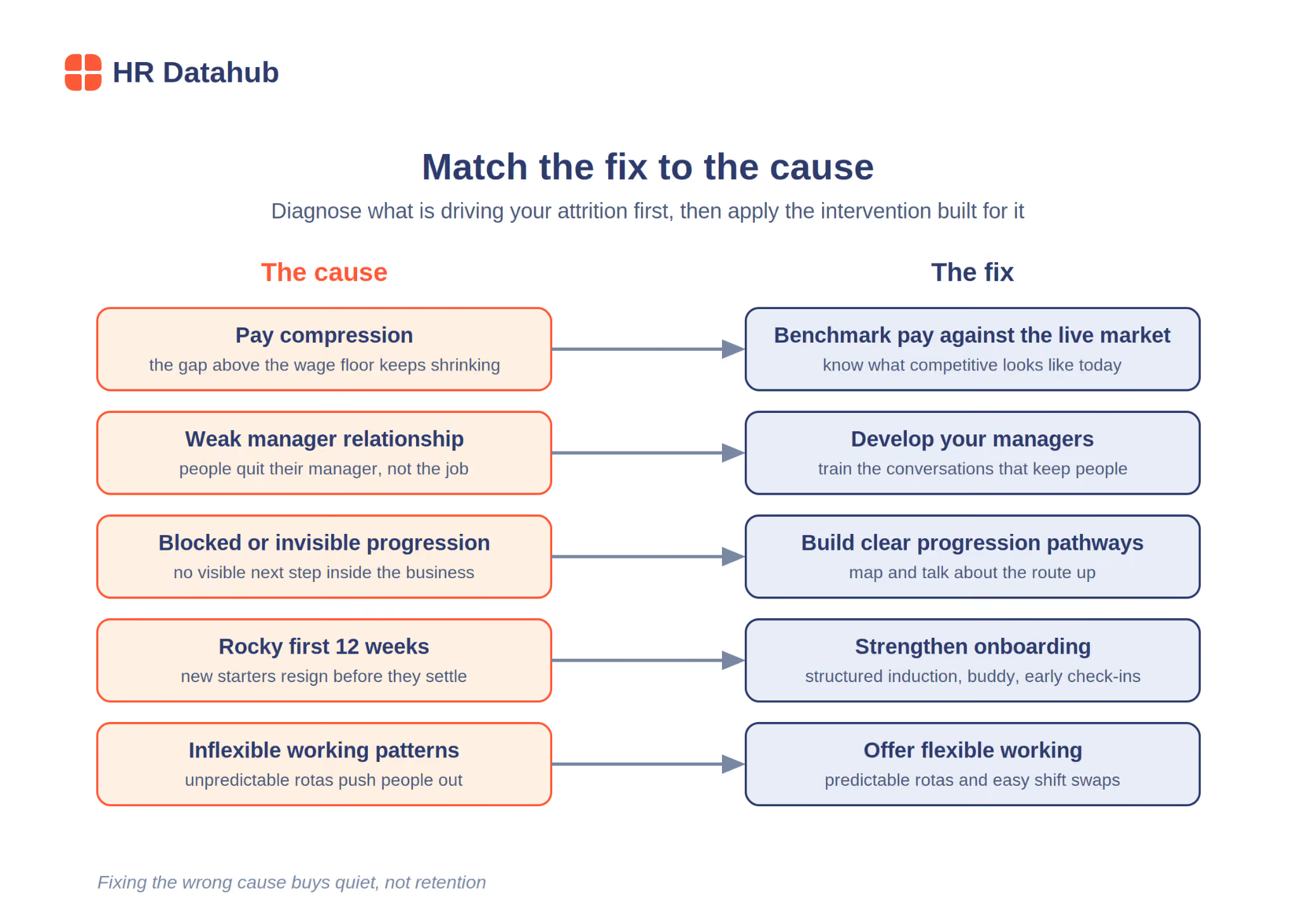
In my experience, five root causes explain most of the attrition I see in mid-market UK businesses:
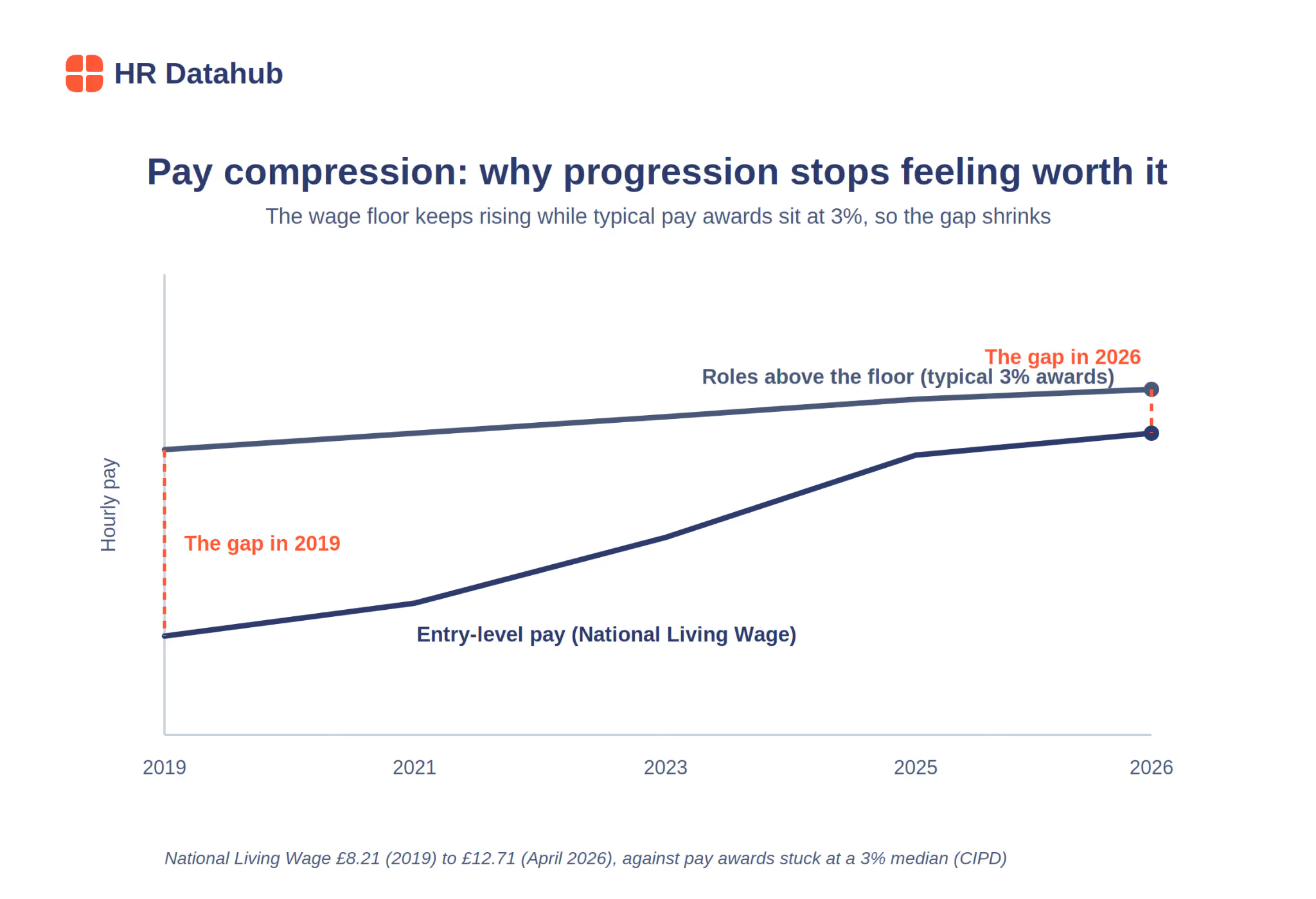
- Pay compression: Take a warehouse operative on the National Living Wage who's been asked to step up as team leader for an extra 50 pence an hour. That's not a big enough jump to justify the extra hassle, so most employees won't bother. And the same logic hits existing supervisors when the gap shrinks between them and the people in the pay band below. HR Datahub's 2026 Pay Trends Survey already flags this as the risk most teams underestimate in hourly-heavy sectors.
- A weak manager relationship: People don't quit their jobs; they quit their manager, an adage that's held up for over fifty years because, as the figure above shows, it's still usually the single biggest driver of attrition.
- Blocked or invisible career progression: If your staff can't see a clear growth path, they'll look for one somewhere else. LinkedIn's 2025 Workplace Learning Report found 88% of organisations are concerned about retention, and career development is their number one lever for it.
- A rocky first 12 weeks. CIPD's 2024 Resourcing and Talent Planning Report found that 41% of organisations that hired in the last year had recruits resign within their first 12 weeks. That's attrition before someone's even had the chance to settle in.
- Inflexible working patterns: For shift-based teams, that means unpredictable rotas; for remote and hybrid teams, it's rigid hours or a blanket return-to-office mandate. CIPD's 2025 flexible working research found 1.1 million UK workers left a job in the past year because they lacked flexibility.
These causes often overlap, so it helps to know which to tackle first. Culture and management issues usually run deepest, but they're also the slowest to fix, with years of institutional change, and not just a policy tweak. Pay is different: it's genuinely the fastest lever to pull if the budget's there, which is why I'd usually start there when I can.
However, the most common misdiagnosis I see some employers make is increasing pay without checking the actual reason employees leave. Do it too often and you end up with what I half-jokingly call jail syndrome.
Jail syndrome: when people are paid too well to leave a job they've stopped enjoying. They stay, but they're no longer engaged with the work.
HR Datahub’s 5-step process to reduce employee attrition in the UK
Here are five proven fixes for reducing employee attrition. Not every business needs all five; just pick the ones that relate to your team:
1. Benchmark pay against the live market
If pay is the reason for employee attrition, the goal is to find what competitive pay looks like for that specific role, level, and location right now. The market moves faster than most employers assume, and your staff usually know first. If the warehouse down the road starts paying 15p more an hour, employees will hear about it. And what they’re seeing the market pays matters more than what last year's survey said it paid.
The National Living Wage rose to £12.71 an hour in April 2026, and people will move for a few pence more when the job is, in practice, the same job. Meanwhile, CIPD's 2026 Labour Market Outlook shows pay awards stuck at a median of 3% for eight consecutive quarters, so the salary gap between entry-level roles and those above them keeps shrinking.
Live data is how you know where you actually stand. Greater Anglia used live pay data from HR Datahub to benchmark pay based on real market data and back its reward decisions with traceable evidence it could defend internally. So, run that check before you increase pay, because good data will also tell you when pay isn't the real problem.
Note that HR Datahub runs on live job-advert data, not your own employee records. For senior or highly specialist roles, a traditional survey with proper levelling still earns its place.
To see how your churn compares before you benchmark pay, our breakdown of turnover rates by industry shows the typical rate for your sector. If retail is where your attrition sits, our guide to employee retention in retail covers the sector-specific fixes.
2. Fix the employee-manager relationship
As I covered above, a weak manager relationship is usually the deepest cause on this list, and thankfully one of the cheapest to fix. Gallup's analysis of preventable turnover found that 42% of people who left voluntarily said their manager or organisation could have done something to keep them, most commonly by simply asking.
So make those conversations a routine part of every manager's job:
- Run one-to-ones every couple of weeks where employees can discuss the overall work condition, including pay, progression, and workload, rather than just updates on tasks.
- Train managers to handle those conversations properly. Most attrition-saving conversations fail because the manager didn't know what to say or never asked at all.
- Give people a simple, known route to raise a pay or progression concern before it becomes a resignation letter.
- Stop promoting purely on technical skill. If your best engineer or highest-selling rep becomes a manager, build the people skills deliberately, because they don't arrive with the job title.
None of these needs headcount or budget. It needs training and time.
3. Build clear progression pathways
Building a visible career progression path in your business is one of the most controllable retention levers you have. In practice, it comes down to a few moves:
- Map a route for every role: From entry-level through supervisor and into management, with the skills and rough timelines spelled out, then talk about it openly rather than keeping it in an HR folder.
- Treat cross-industry competition as real: A warehouse picker and a barista sit at roughly the same level in practice, and people will move for very little if another employer shows a clearer next step.
- Mirror the businesses that do this well: McDonald's brings in part-timers and students, then routes them into genuine undergraduate and management schemes, so a stopgap job becomes a real career path.
Employees would stay longer at a company that invests in their growth, so use career development as the lever when you genuinely can’t increase pay.
4. Strengthen onboarding
Someone who resigns in their first few months wanted the job when they accepted it, so something in those early weeks changed their mind. That makes early attrition the most fixable kind, yet it’s also the least measured: only 31% of organisations that track their turnover calculate what it costs them, per CIPD's 2024 Resourcing and Talent Planning Report. If you can't put a number on it, it's hard to build the case for fixing it.
The fix is a structured onboarding, not just a first day and a login. A clear 30-60-90-day plan, a named buddy who isn't the line manager, and a check-in at two weeks instead of waiting for the probation review all catch problems while they're still fixable.
This matters most in high-volume sectors, where new starters are often thrown straight into a live shift with minimal ramp-up.
5. Offer flexible working arrangements
Flexibility isn't just an office-worker perk, and it hits younger workers the hardest. The same CIPD research shows that 8% of 18 to 24-year-olds and 7% of 25 to 34-year-olds left a job due to a lack of flexible working in the past year, compared with 3% of the workforce as a whole.
In hourly and shift-based roles, flexibility means predictable rosters, enough notice of a shift change, and a straightforward way to swap shifts with a colleague instead of needing management sign-off for everything. Our guide to employee retention in hospitality covers this in more depth for shift-based teams.
None of this requires a four-day week or full remote working. Small, consistent predictability is often enough to change the calculation.
How to measure employee attrition
Fixing the causes above only counts if you can see it in the numbers, so track these alongside your headline attrition rate:
- Attrition by segment, and by who's leaving: A flat company-wide rate can hide a hospitality branch with an attrition rate of 60% while head office sits at 12%. And it won't tell you whether you're losing underperformers or your best people, which is a far bigger problem. Break it down by site, role, years worked, and performance.
Formula: segment attrition rate = (leavers in the segment ÷ average headcount in the segment) × 100.
- Early resignation rate: Track how many people leave within their first six months to a year, not only the 12-week marker used in the onboarding section above. A cluster in that wider window still usually points to onboarding or culture, not just pay, because this means people arrived, formed a view, and left.
Formula: early resignation rate = (leavers within their first 12 months ÷ total new starters in the same period) × 100.
- Cost of turnover: Gallup estimates replacement costs at around 40% of salary for frontline roles, 80% for technical specialists, and up to 200% for leadership. Put a number on what your attrition actually costs, and the business case for fixing it writes itself.
Formula: cost of turnover = number of leavers × (annual salary × replacement cost percentage for the role type).
- Exit interview themes: Have someone other than the line manager run these. Employees rarely tell the truth to the manager whose actions or inactions caused them to leave. And look for patterns over single answers: one leaver's reason tells you little, but five leavers in a quarter citing the same manager or pay gap tells you exactly where to focus.
Frequently asked questions
What is a good attrition rate?
There's no single good attrition rate; it depends on your sector. CIPD's turnover benchmarking puts the UK average at 34%, with public administration around 25%, hospitality above 50%, and transient roles like hairdressing sometimes exceeding 100%. Compare yourself with your sector, not the whole economy.
What's the difference between attrition and turnover?
Attrition and turnover mean the same thing to most UK employers. Some HR teams draw a finer distinction: turnover covers every departure, whether or not you replace the person, while attrition specifically means departures where the role isn't filled, and headcount shrinks.
What are the 5 C's of employee retention?
The 5 C's most commonly used in UK HR practice are compensation, career development, culture, communication, and connection. They're a checklist rather than a formula, so work through each one to see what's actually missing instead of assuming pay is always the answer.
What are the 3 R's of employee retention?
The 3 R's usually refer to respect, recognition, and reward: treating people fairly, acknowledging good work specifically, and paying competitively for the role. It's a simpler version of the same idea as the 5 C's.
Start reducing attrition now
Start with the diagnosis. Pull your attrition rate by site, role, and employee’s length of service, run a few exit interviews if you haven't recently, and be honest about which of the causes above is actually making people leave before you spend a single pound on the fix.
When pay is part of the answer, back the decision with live evidence you can defend, not a survey that was accurate over 6 months ago. If you want to see what your company’s pay looks like against the current market, book a call today to see how HR Datahub can help you make more confident pay decisions.
LATEST WEBINAR
.avif)
Guides, templates and tools to help you approach pay with more confidence, clarity and consistency.


Read through more blogs

%2520(1).avif)














.avif)
.avif)



.avif)






.avif)




.avif)
.avif)
.avif)
.avif)
.avif)
.avif)
.avif)
.avif)